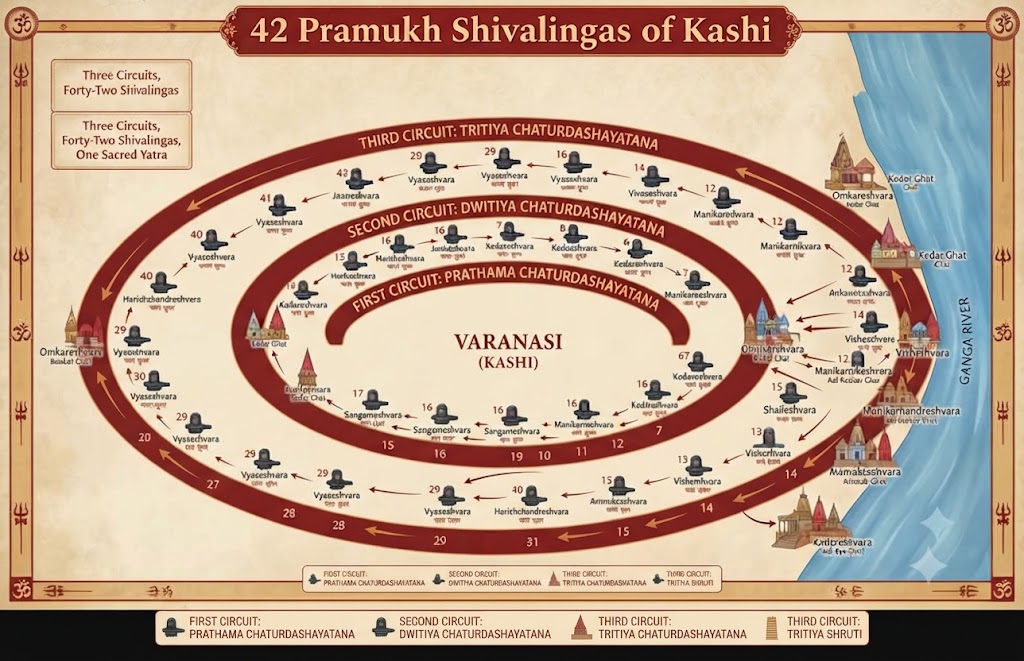
The 42 Pramukh Shivalingas of Kashi Circuit Map banner

Skanda Purāṇa · Kāśī Khaṇḍa, Ch. 73

The 42 Pramukh Shivalingas of Kāśī

Three fourteen-linga pilgrimage circuits — Prathama, Dwitiya and Tritiya Chaturdashayatana — said to lead, step by step, toward Moksha.

Overview

One Yatra, Three Circuits

The Kashi Khand — the vast Varanasi section of the Skanda Purana — names hundreds of Shiva lingas scattered across the sacred city, but singles out forty-two as its Mukti-lingas, the principal forms whose worship is said to lead most directly toward liberation. Tradition groups these forty-two into three pilgrimage circuits of fourteen each, called Chaturdashayatana — “the abode of fourteen” — walked in sequence as a single, unified yatra.

The first fourteen are introduced together, and in unusual detail, in the text’s seventy-third chapter, where Shiva himself names them to Parvati and Kartikeya. The verse below opens that account.

एतानि हि महालिङ्गान्यत्र पूज्यानि यत्नतः,
नामश्रवणमात्रेण स्युर्नाराशकराणि हि。
अधिष्ठातृणि चैतस्मिन् क्षेत्रे पुण्यतमे प्रिये,
आराधितानि मोक्षं वा जदते देहधारिणाम्।

Rendered loosely: in this most sacred of groves, these fourteen great lingas deserve especially diligent worship — even the mere hearing of their names is held to dissolve sin, for they preside over this holy field, and devoted worship of them is said to grant liberation to the embodied soul itself.

Kashi Khand, Chapter 73

A note on sourcing: the first circuit is described as a single, well-attested group. The second and third are gathered from more scattered chapters of a text that runs to roughly a hundred chapters and thirteen thousand verses, plus centuries of local pilgrim tradition — so a handful of the less-visited names below are presented mainly by meaning and context rather than a full individual legend. Those are marked as such.
Priests performing Ganga Aarti at Dashashwamedh Ghat, Varanasi

Photo © Wikimedia Commons contributor · CC BY-SA 4.0 · source

First Circuit · Prathama Chaturdashayatana

The First Fourteen

Stops 1–14

Named together, and in unusual detail, in Kashi Khand’s seventy-third chapter — Shiva’s own words to Parvati and Kartikeya. This is the oldest and best-attested of the three circuits, and the one most pilgrims walk first.

Omkareshvara (ओंकारेश्वर) Lord of the Sacred Syllable

Legend. A self-manifested (svayambhu) linga said to hold, in physical form, the five subtle parts of the sound “Om” — akara, ukara, makara, nada and bindu.

Significance. Beholding this linga is said to equal the merit of chanting the Rudra mantra a hundred thousand times; remembering one’s ancestors here is held to grant them Brahmapada, the highest abode.

Trilochaneshvara (त्रिलोचनेश्वर) Lord of the Three Eyes

Legend. Said to have arisen from a flash of light released by Shiva’s third eye — a symbol of the power of inner vision.

Significance. Darshan here is believed to awaken spiritual insight and dissolve ignorance.

Adi Mahadeva (आदिमहादेव) The First Great God

Legend. Held to be the very first form in which Mahadev appeared in Kashi, when Vishnu undertook penance here at the dawn of creation.

Significance. Regarded as one of the oldest lingas in the city; worship here is said to end life’s afflictions.

Krittivaseshvara (कृत्तिवासेश्वर) Lord Clad in Hide

Legend. After slaying Gajasura, a demon descended from Mahishasura who tormented the sages, Shiva is said to have worn the demon’s elephant hide as a garment.

Significance. Worship here is believed to free a devotee from fear, enmity and untimely death.

Ratneshvara (रत्नेश्वर) Lord of Jewels

Legend. Established, by tradition, either by the deity of gems and wealth or by King Ratnasena, to propitiate Shiva.

Significance. Darshan and worship are said to dispel poverty and bring prosperity.

Chandreshvara (चन्द्रेश्वर) Lord of the Moon

Legend. The Moon, wasting under a curse from King Daksha, is said to have performed intense penance here; Shiva relented and placed the moon upon his own forehead.

Significance. Worship on Mondays or the full moon (Purnima) is held to bring mental peace and ease lunar afflictions (Chandra Dosha).

Kedareshvara (केदारेश्वर) Lord of the Field

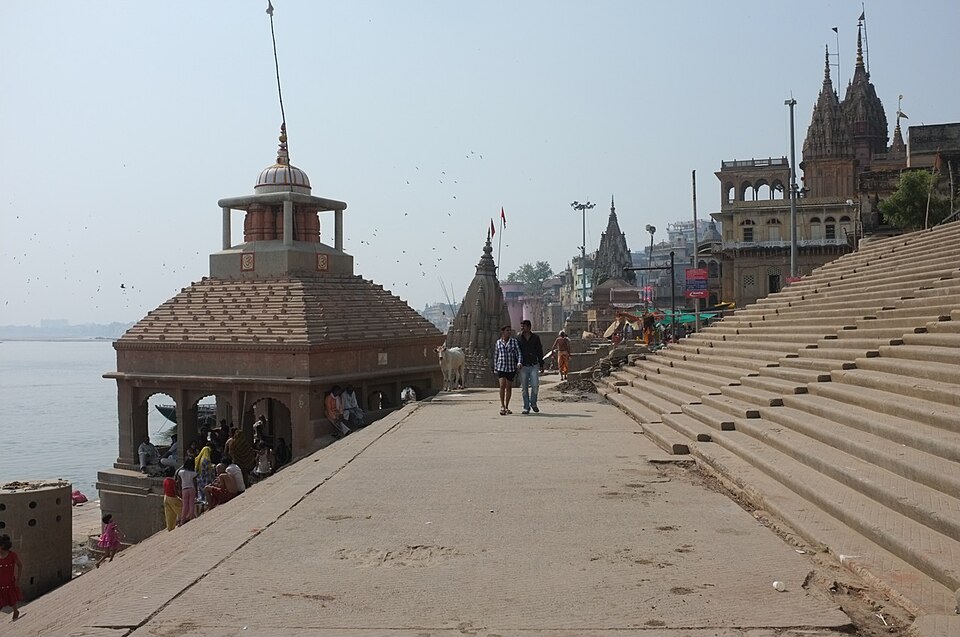
Kedar Ghat

Legend. For devotees unable to travel to Kedarnath in the Himalayas, Shiva is said to have manifested here in the southern part of Kashi.

Significance. Worship at Kedar Ghat is held to carry the same merit as a pilgrimage to the Kedarnath Jyotirlinga.

Dharmeshvara (धर्मेश्वर) Lord of Righteous Law

Mir Ghat

Legend. Yamaraja, lord of Dharma, is said to have established and worshipped this linga to gain the authority to judge every being’s deeds.

Significance. Its devotees are said to be spared the reckoning of Yama and the torments of hell.

Atmavireshvara (आत्मवीरेश्वर) Lord of Inner Valour

near Sankata Ghat

Legend. Worshipped, by tradition, by gods and sages seeking to master the self and attain supreme courage.

Significance. Said to instil inner strength, courage and spiritual fortitude in its devotees.

Kameshvara (कामेश्वर) Lord of Desire

Legend. After Shiva reduced Kamadeva, god of love, to ashes, and his wife Rati grieved, Shiva is said to have granted that Kamadeva be restored here in bodiless (Ananga) form.

Significance. Worship is believed to fulfil righteous desires and bring harmony to family life.

Vishvakarmeshvara (विश्वकर्मेश्वर) Lord of the Divine Architect

Legend. Installed, by tradition, by Vishvakarma, celestial architect of the gods, seeking blessings for the building and protection of Kashi itself.

Significance. Held to be especially auspicious for artisans, builders and those in craft or industry.

Manikarnikeshvara (मणिकर्णिकेश्वर) Lord of the Jewelled Earring

Manikarnika Ghat

Legend. Said to have been established by Shiva after Parvati’s earring fell into the Chakrapushkarini tank, giving the site its name.

Significance. Darshan at Manikarnika Ghat is believed to free a devotee from the cycle of birth and death.

Avimukteshvara (अविमुक्तेश्वर) The Never-Forsaken Lord

beside the Vishwanath sanctum

Legend. Shiva is said to have vowed never to abandon this ground, even at the dissolution of the universe — hence “Avimukta,” the never-forsaken.

Significance. Standing beside the main sanctum, this site is traditionally associated with the Tarak Mantra given to the dying in Kashi.

Visheshvara (विश्वेश्वर) Lord of the Universe — Baba Kashi Vishwanath

Legend. The principal Jyotirlinga of Kashi, sovereign over the entire sacred city.

Significance. The culmination of the fourteen-linga circuit: darshan here is said to uproot the three kinds of suffering — physical, divine and material — at their root, and grant liberation.

Second Circuit · Dwitiya Chaturdashayatana

The Second Fourteen

Stops 15–28

Gathered from across the Kashi Khand’s middle chapters — ghat-side lingas tied to rivers, seasons and the daily rhythm of worship. Sourcing is more scattered here than in the first circuit; a few names are marked below as thinly documented.

Shaileshvara (शैलेश्वर) Lord of the Mountain

Marhia Ghat, ShailputriKKh 66

Legend. Raised, by tradition, with the help of Giriraja’s own workers; Parvati is said to have asked that Shiva remain within it, and he agreed.

Significance. Bathing in the Varuna and worshipping here is said to grant Moksha; devotees are held to be cherished like the Goddess’s own children.

Sangameshvara (सङ्गमेश्वर) Lord of the Confluence

Adi Keshav GhatKKh 58

Legend. Marks the meeting of the Ganga and Varuna rivers, where Vishnu is said to have washed his feet on first arriving in Kashi — the spot known as Padodak Tirtha.

Significance. Worship here is believed to please Vishnu and bring prosperity.

Madhyameshvara (मध्यमेश्वर) Lord of the Centre

Daranagar

Legend. Once regarded as the literal midpoint of sacred Kashi, from which the city’s other pilgrim circuits were traditionally measured.

Significance. Worship on Ashtami and Chaturdashi days is said to bring great happiness.

Svarlineshvara (स्वर्लीनेश्वर) Lord Merged in Heaven

fewer sources survive One of the less-documented names among the forty-two; the epithet points to union with the celestial realm. It is counted among the potent lingas Shiva describes to Parvati, though a detailed narrative for this particular form is not widely preserved in accessible sources.

Harishchandreshvara (हरिश्चन्द्रेश्वर) Lord of Harishchandra

Harishchandra GhatKKh 61

Legend. Associated with the legendary King Harishchandra, renowned for unwavering truthfulness, whose name is attached to Kashi’s second cremation ground.

Significance. Worship here is said to instil truthfulness in the devotee.

Gabhastishvara (गभस्तीश्वर) Lord of Radiant Light

fewer sources survive Gabhasti means a ray of light. The name places this linga among the radiance-linked forms catalogued in the Kashi Khand’s later chapters, though its individual story is not widely preserved in popular sources.

Gopreksheshvara (गोप्रेक्षेश्वर) Lord Who Beholds the Cow

Lal Ghat · also called Gauri ShankarKKh 97

Legend. Kashi Khand places this linga to the east of Adi Mahadev.

Significance. Worship is said to carry the merit of Godana — the traditional gift of a cow.

Trisandhyeshvara (त्रिसन्ध्येश्वर) Lord of the Three Junctures

Trisandhi TirthaKKh 61

Legend. Named for the three daily junctures of prayer — Sandhya Vandan at morning, noon and evening.

Significance. Bathing at Trisandhi Tirtha and worshipping here is held to carry the merit of having studied the Vedas.

Jambukeshvara (जम्बुकेश्वर) Lord of the Jambu Tree

near Bada Ganesh

Legend. One of the many forms named in Kashi Khand’s long catalogue of the city’s lingas.

Significance. Sincere worship is said to free a devotee from sin and assure a place in heaven.

Upashanteshvara (उपशान्तेश्वर) Lord of Deep Peace

Bhosala GhatKKh 97

Legend. Described as standing northeast of Bhadreshvara.

Significance. Merely touching this linga is said to bring profound mental peace and cleanse sins accumulated over a long time.

Jyeshtheshvara (ज्येष्ठेश्वर) The Foremost Lord

Sapt SagarKKh 63

Legend. Kashi Khand recommends darshan on the fourteenth day of the bright fortnight of Jyeshtha month (May–June).

Significance. Sin accumulated over years is said to vanish as darkness before sunrise; offerings made here for one’s ancestors are considered especially meritorious.

Vyaghreshvara (व्याघ्रेश्वर) Lord of the Tiger

Bhoot BhairavKKh 65

Legend. Shiva is said to have emerged from this linga to slay the demon Dundubhi, who had taken a tiger’s form to attack a devotee absorbed in worship.

Significance. Worship here is held to remove obstacles and bring success in one’s undertakings.

Nivaseshvara (निवासेश्वर) Lord of the Dwelling

fewer sources survive The name suggests Shiva’s abiding presence (nivasa, “dwelling place”). It is among the more obscure of the forty-two, without a widely preserved individual legend in accessible sources.

Shukreshvara (शुक्रेश्वर) Lord of Shukra

Kalika GaliKKh 16

Legend. Named for Shukracharya, preceptor of the demons, whom Shiva is said to have revived and blessed at this site.

Significance. A full year of devoted worship is said to bless the devotee with good children and lasting happiness.

Third Circuit · Tritiya Chaturdashayatana

The Third Fourteen

Stops 29–42

The closing stretch of the pilgrimage, drawn largely from the same chapter 73 group of “fourteen potent lingas” that opens the whole list, plus a handful of forms named elsewhere in the text — ending, fittingly, at the Lord of Knowledge.

Vyaseshvara (व्यासेश्वर) Lord of Sage Vyasa

Ghantakarna Pushkarini, Karn Ghanta

Legend. Installed, by tradition, by the sage Ved Vyasa, compiler of the Vedas, who is said never to have left Kashi again after establishing it.

Significance. Bathing in the Ghantakarna tank and taking darshan here is held to grant ultimate knowledge — and even the merit of dying in Kashi, wherever one’s death actually occurs.

Tarkeshvara (तारकेश्वर) Lord Named for Tarakasura

Legend. The Shiva Purana tells how the demon Tarakasura, before his defeat by Kartikeya, begged Shiva’s forgiveness and was granted that his own name be forever joined to the Lord’s.

Significance. Worshipped in this age as Tarkeshwar Mahadev, with shrines near Manikarnika Ghat and the Vishwanath temple.

Amriteshvara (अमृतेश्वर) Lord of Immortality

ChowkKKh 73 · 94

Legend. The first-named of the fourteen especially potent lingas Shiva describes to Parvati in Kashi Khand’s seventy-third chapter.

Significance. Tradition holds that even the dead may find life at its touch, and the living, freedom from the fear of rebirth.

Chandishvara (चण्डीश्वर) The Fierce Lord

KKh 73

fewer sources survive Named among the same group of fourteen potent lingas in Kashi Khand’s seventy-third chapter; the epithet Chandi marks Shiva’s fierce, world-protecting aspect. A fuller individual legend is not widely preserved in accessible sources.

Karuneshvara (करुणेश्वर) Lord of Compassion

fewer sources survive Karuna means compassion. The name marks this linga as an embodiment of Shiva’s merciful aspect among the forty-two, though a detailed individual legend is not widely preserved in accessible sources.

Mokshadvareshvara (मोक्षद्वारेश्वर) Gateway to Liberation

KKh 94

Legend. One of the lingas Shiva names among the powerful forms clustered near the Chakrapushkarini.

Significance. Kashi Khand promises that a devotee who worships here will always find Moksha — release from the cycle of rebirth.

Swargadvareshvara (स्वर्गद्वारेश्वर) Gateway to Heaven

Brahmanal, Swarg DwariKKh 94

Legend. Placed near the Chakrapushkarini/Manikarnika area; the surrounding locality still carries this linga’s name, Swarg Dwari.

Significance. Worship here is said to cleanse sin and assure heaven after death.

Vriddhakaleshvara (वृद्धकालेश्वर) The Ancient Lord of Time

DaranagarKKh 24

Legend. Kashi Khand tells of a devotee named Vriddha Kal who, after a pious former life, settled in Kashi and worshipped this linga so faithfully that it came to bear his name.

Significance. Worship is said to fulfil wishes and free one from disease and poverty; the nearby Kalodak well is held to cure ailments.

Vrisheshvara (वृषेश्वर) Lord of the Sacred Bull

Gorakhnath, Maidagin

Legend. Counted among the many forms Nandi is said to have gathered into Kashi from Vrishabhadhwaja Tirtha.

Significance. Devotees hold that its worship brings lasting contentment.

Maheshvara (महेश्वर) The Great Lord

KKh 73

fewer sources survive One of the fourteen potent lingas in Kashi Khand’s seventy-third-chapter group. Mahesha, “great lord,” is among Shiva’s most universal epithets, marking this form as an embodiment of his all-encompassing majesty rather than a site with its own separate narrative.

Brahmeshvara (ब्रह्मेश्वर) Lord of Brahma

Khalispura, near Dashashwamedh Ghat

Legend. After performing ten Ashvamedha sacrifices with King Divodasa at what became Dashashwamedh Ghat, Brahma is said to have installed this linga and continued worshipping Shiva from beside it.

Significance. Its devotees are said to find a place in Brahmaloka.

Langlishvara (लाङ्गलेश्वर) Lord of the Plough

fewer sources survive Langala means plough. The name is thought to carry agrarian imagery from within the Kashi Khand’s long catalogue of lingas, though its individual story is not widely preserved in accessible sources.

Nandikeshvara (नन्दीश्वर) Lord of Nandi

fewer sources survive Named for Nandi, Shiva’s bull and constant attendant. Tradition holds that this linga’s original site has long been lost to memory — the one member of the forty-two without a confirmed, continuously worshipped shrine today.

Jnaneshvara (ज्ञानेश्वर) Lord of Knowledge — Gyaneshwar

ChowkKKh 73

Legend. The last-named of the fourteen potent lingas in Kashi Khand’s seventy-third chapter, and so the final station of the entire forty-two-linga circuit.

Significance. Shiva promises that worshipping him here — or merely reciting the names of these fourteen lingas — grants supreme knowledge and, ultimately, Moksha.

Practice

Special Rules for the Pilgrimage

  • The fourteen (or, for the full round, forty-two) lingas are traditionally visited in sequence, not in any order — the circuit is a single continuous yatra.
  • The Kashi Khand recommends undertaking it either during the dark fortnight (Krishna Paksha) of the month of Vaishakh, or between the first and fourteenth days of the bright fortnight (Shukla Pratipada to Chaturdashi) of any month.
  • Many present-day locations are traditional identifications rather than archaeological certainties — centuries of rebuilding, relocation and loss mean a handful of these shrines (Nandikeshvara among them) no longer have a confirmed site.