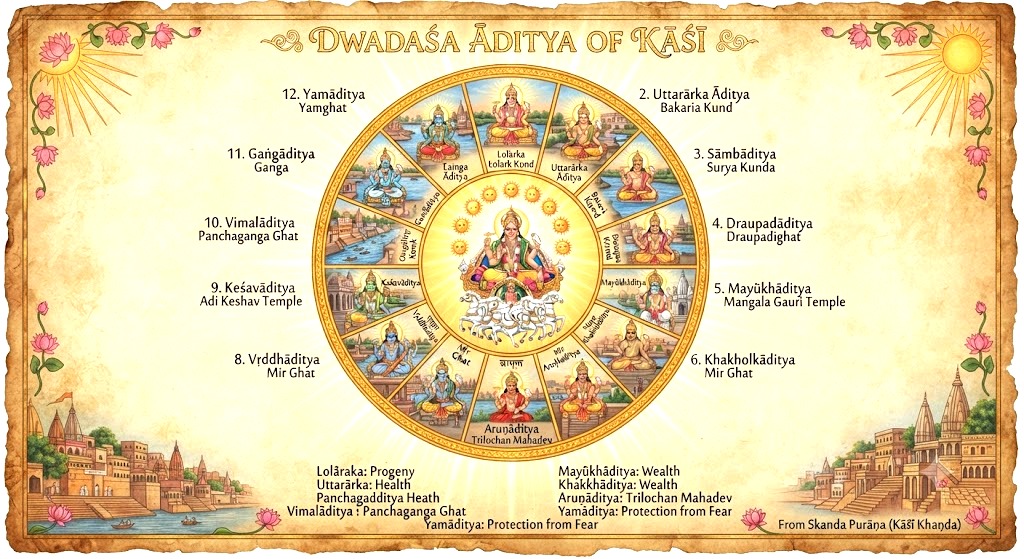
Dwadaśa Āditya of Kāśī
The Divine Legends, Shrines, and Mantras of the Twelve Suns based on Skanda Purāṇa (Kāśī Khaṇḍa)
The Divine Legends, Shrines, and Mantras of the Twelve Suns based on Skanda Purāṇa (Kāśī Khaṇḍa)
According to the Skanda Purāṇa (*Kāśī Khaṇḍa*), when King Divodāsa ruled Kashi with absolute righteousness, Lord Shiva and the celestial gods sought a way back into the city. Lord Surya was sent first to survey and test the city's spiritual fabric. Upon entering Kashi, Surya Dev was transfixed by its transcendental peace and realized that returning to Mount Mandara would be unwise.
Rather than leaving, Surya fractured his immense solar energy into **twelve distinct resplendent manifestations**. Each form settled into a specific sacred geography of Kashi, anchoring divine light, healing humanity, and guarding the holy space.
The Trembling Sun of Progeny: Skanda Purāṇa narrates that when Surya Dev arrived in Kashi, he was so overwhelmed with divine ecstasy that his earrings shook violently. The sacred pool formed here became known as Lolārka (the trembling sun). It is the premier site where parents pray for lineage continuity and ancestral redemption (*Pitri Rin*).
The Northern Guardian of Health: Representing the sun's northward journey (*Uttarāyana*), this form was established to channel healing solar prana that neutralizes chronic imbalances. Sages noted that worshippers here receive immunity from deep-seated physical illnesses.
The Cured Prince: Lord Krishna’s son, Samba, was cursed with severe leprosy due to a misunderstanding engineered by Sage Narada. Advised that only intense sun worship in Kashi could heal him, Samba traveled here, established this shrine, and was completely cured of his affliction.
The Royal Bestower of Power: According to the Skanda Purāṇa, King Drupada of Panchala performed rigorous penance here to invoke solar energy for political stability and righteous leadership. The shrine became renowned for bestowing unshakeable confidence and authority.
The Dispeller of Poverty: Named after *Mayūkha* (rays of light), this form of Surya was invoked by divine seekers to pierce through layers of ignorance and financial scarcity. Kashi Khand emphasizes that sincere prayer here illuminates intellect and wealth.
The Celestial Traveler: As the sun traverses the ether (*Khakah*), this aspect governs longevity and the vital breath (*Prana*) circulating through the cosmos. Sages meditating here experienced a dramatic surge in life force and physical stamina.
The Dawn Breaker: Established by Sage Aruṇa, the divine charioteer of Surya, this shrine captures the pristine energy of dawn (*Aruna*). It is believed to chase away the darkest despair from a devotee's mind, much like morning light dispels night.
The Ancient Sustainer: According to Kashi Khand legend, an aged sage named Hariv, devoid of physical strength to perform rituals, performed intense mental penance here. Surya appeared in his ancient (*Vriddha*) yet radiant form, blessing him with eternal vigor and vitality.
The Fusion of Surya and Vishnu: Situated at Rajghat where the Varuna river meets the Ganga, this shrine represents the non-difference between Lord Vishnu (Kesava) and Surya. Worshipping here bridges material duties with spiritual liberation (*Moksha*).
The Pure Spot of Cleansing: Skanda Purāṇa shares the story of a righteous seeker named Vimal who performed penance here to wash away deep karmic stains from past births. Surya manifested in an immaculate form, granting him spiritual purity and total physical healing.
The Solar-Ganga Synthesis: Resting right on the banks of Mother Ganga, Gaṅgāditya unites the cooling nectar of the holy river with the fierce, purifying heat of the sun. It protects pilgrims from water-borne vulnerabilities and negative ancestral impressions.
The Conqueror of Mortality: As Surya is the biological father of Yama (the god of justice and death), this shrine named Yamāditya represents the ultimate power to transcend untimely death (*Akal Mrityu*) and severe karmic retribution.